Procurement Wallet
Handles paid data requests, merchant verification, and route fingerprinting. Designed for machine commerce.
A constitutional runtime sits between agent cognition and economic execution. Sovereign separates cognition from authority.
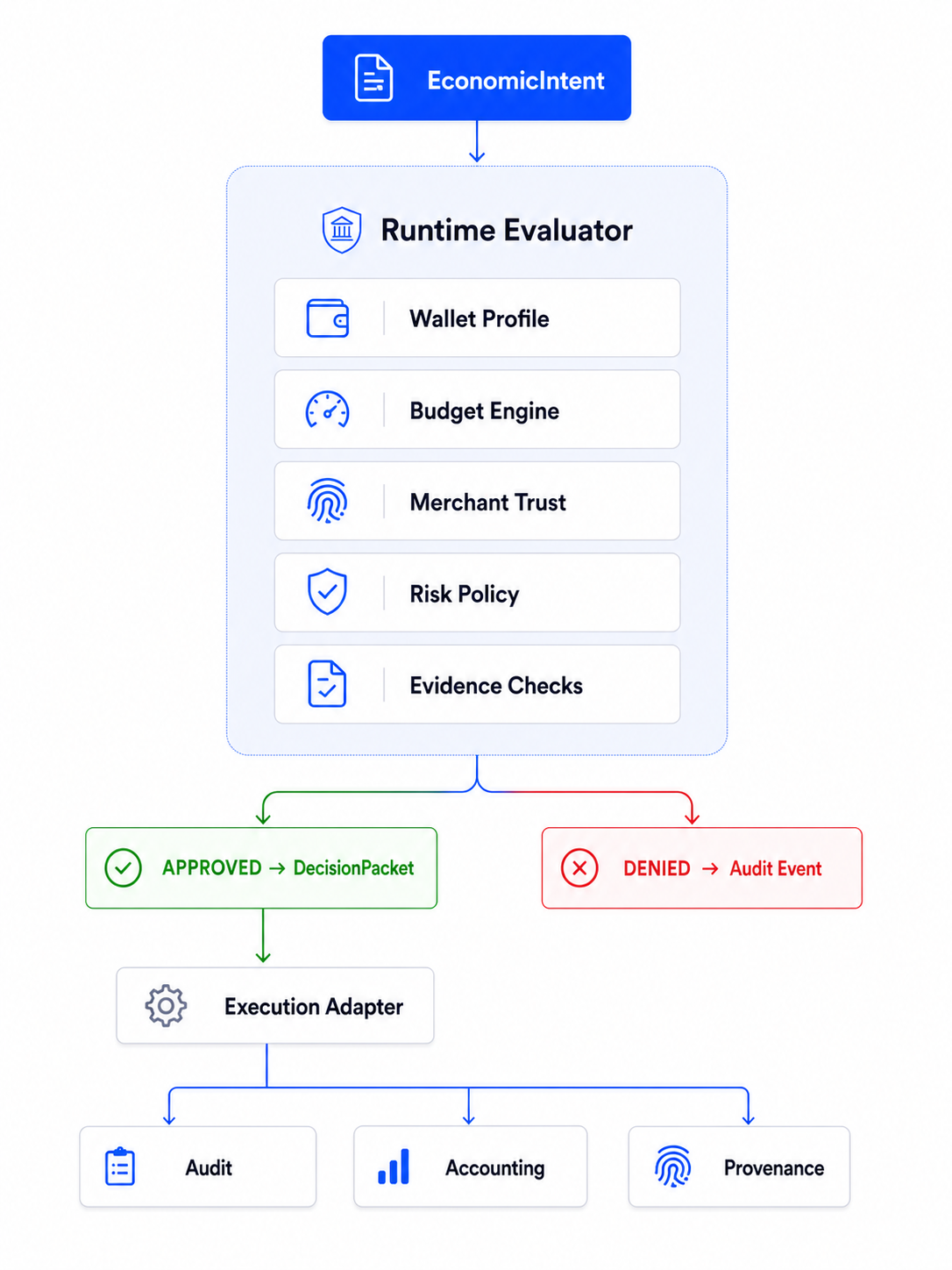
An agent can reason, plan, and request. The wallet only acts after the runtime validates a typed intent against an active constitution.
This is not a permission gate bolted on top. The constitutional runtime is the evaluation path. There is no direct route from agent cognition to wallet execution.
Every wallet carries a compiled constitution: a set of rules that govern which merchants can be paid, how much can be spent, what risk is acceptable, and what evidence the agent must provide.
Instead of handing agents a signing key or a wallet adapter with open-ended methods, Sovereign exposes a single typed intent surface. Agents declare what they want to accomplish: which wallet, which merchant, which route, what data they need.
The intent is normalized, validated for schema completeness, and passed to the runtime evaluator. The agent never interacts directly with the execution layer.
await client.proposeIntent({
  walletId: "wallet_procurement_demo",
  agentId: "akasha_agent",
  kind: "mcp.paid_data_request",
  merchantId: "merchant_akasha_market_data",
  routeId: "route_eth_snapshot_v1",
  taskId: "eth_market_cycle_001",
  idempotencyKey: "eth_snapshot_001"
});Not all wallets are equal. Each profile type carries its own constitution, budget limits, permitted merchants, and risk tolerances.
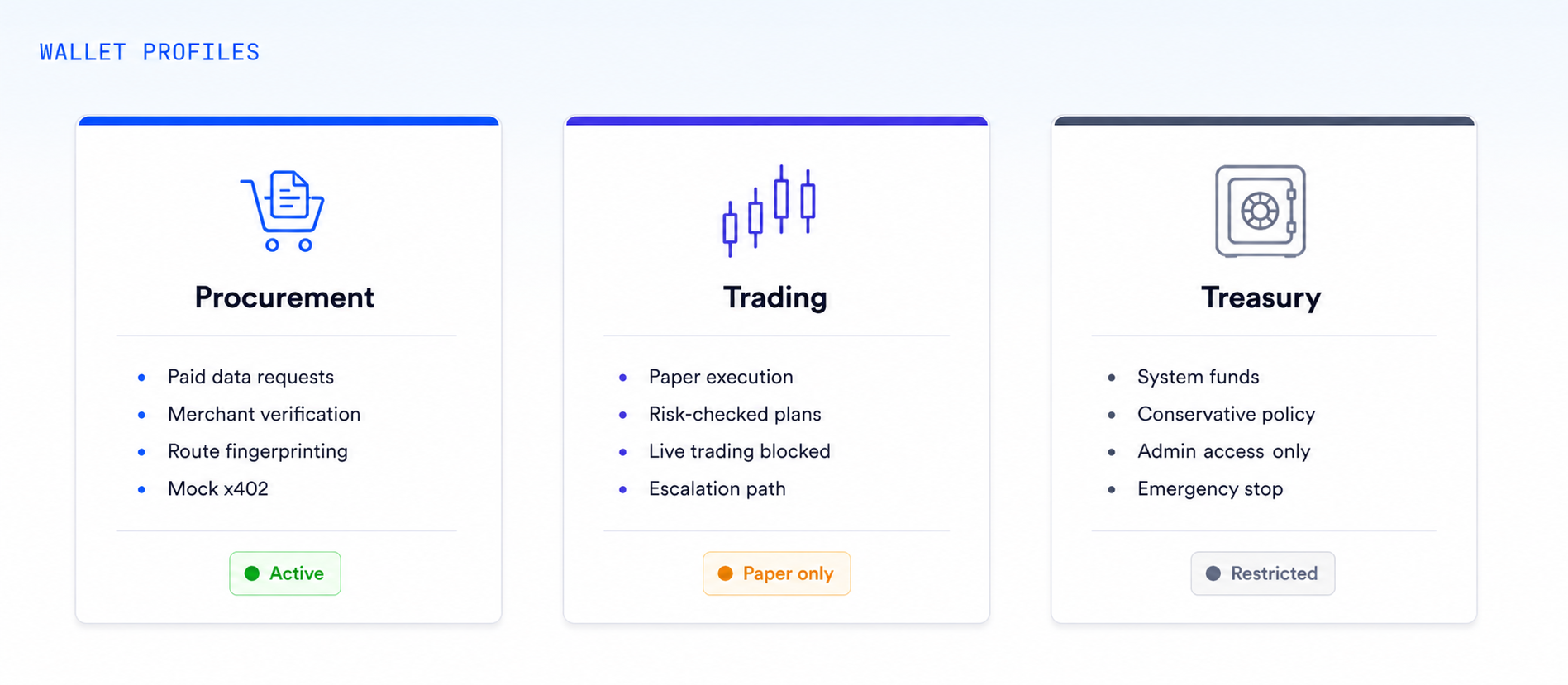
Handles paid data requests, merchant verification, and route fingerprinting. Designed for machine commerce.
Governs paper execution from risk-checked trade plans. Live trading denied by default unless explicitly escalated.
Holds system-level authority for fund management. Restricted by the most conservative constitutional rules.
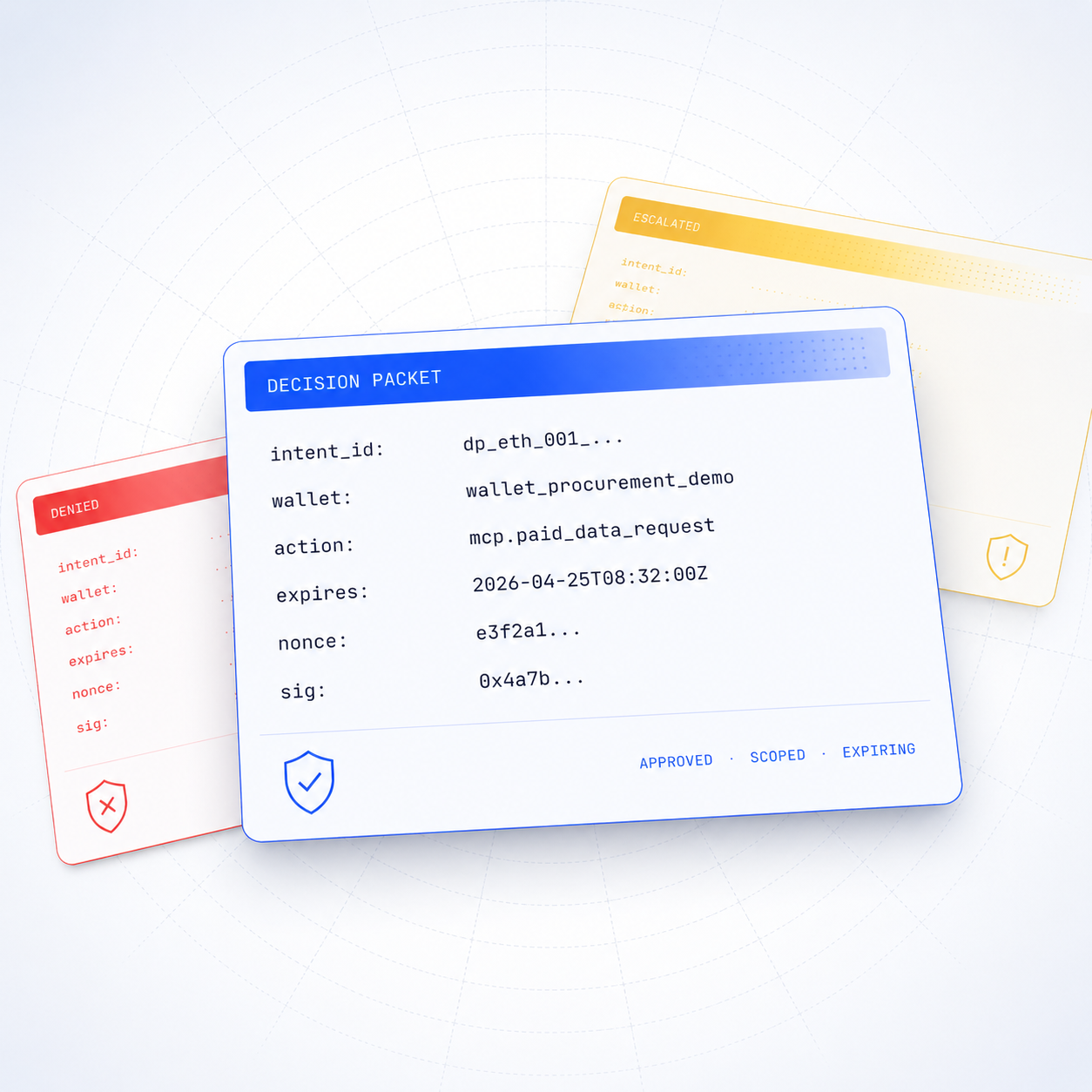
When the runtime approves an intent, it issues a DecisionPacket. The packet is scoped to the specific action, carries a short expiry, includes a nonce, and is signed by the runtime.
The execution adapter verifies the packet before acting. An expired packet is rejected. A replayed nonce is rejected. The packet cannot be used for a different action than what was approved.
Adapters translate approved DecisionPackets into specific protocol actions. No adapter can act without a valid packet.
Simulates machine-readable payment protocol for demo flows.
Executes paper trades without real money. Risk-gated by trade plan.
Placeholder adapters for real on-chain execution. Not enabled.
Every executed action produces structured records that connect the agent decision, the wallet approval, the merchant route, and any downstream artifacts.
Append-only log of every runtime decision, approval, denial, and escalation.
Double-entry-style records for every settled action. Exportable as CSV.
Artifact graph connecting data to the decision that funded it and the plan that used it.
The demo proves every step of the flow locally in under five minutes.