Akasha integration
Akasha is the first agent client for Sovereign Wallet OS. She connects through the SDK-only path and never receives direct wallet authority. The integration is designed to demonstrate that a fully autonomous agent can participate in governed economic workflows without bypassing constitutional controls.
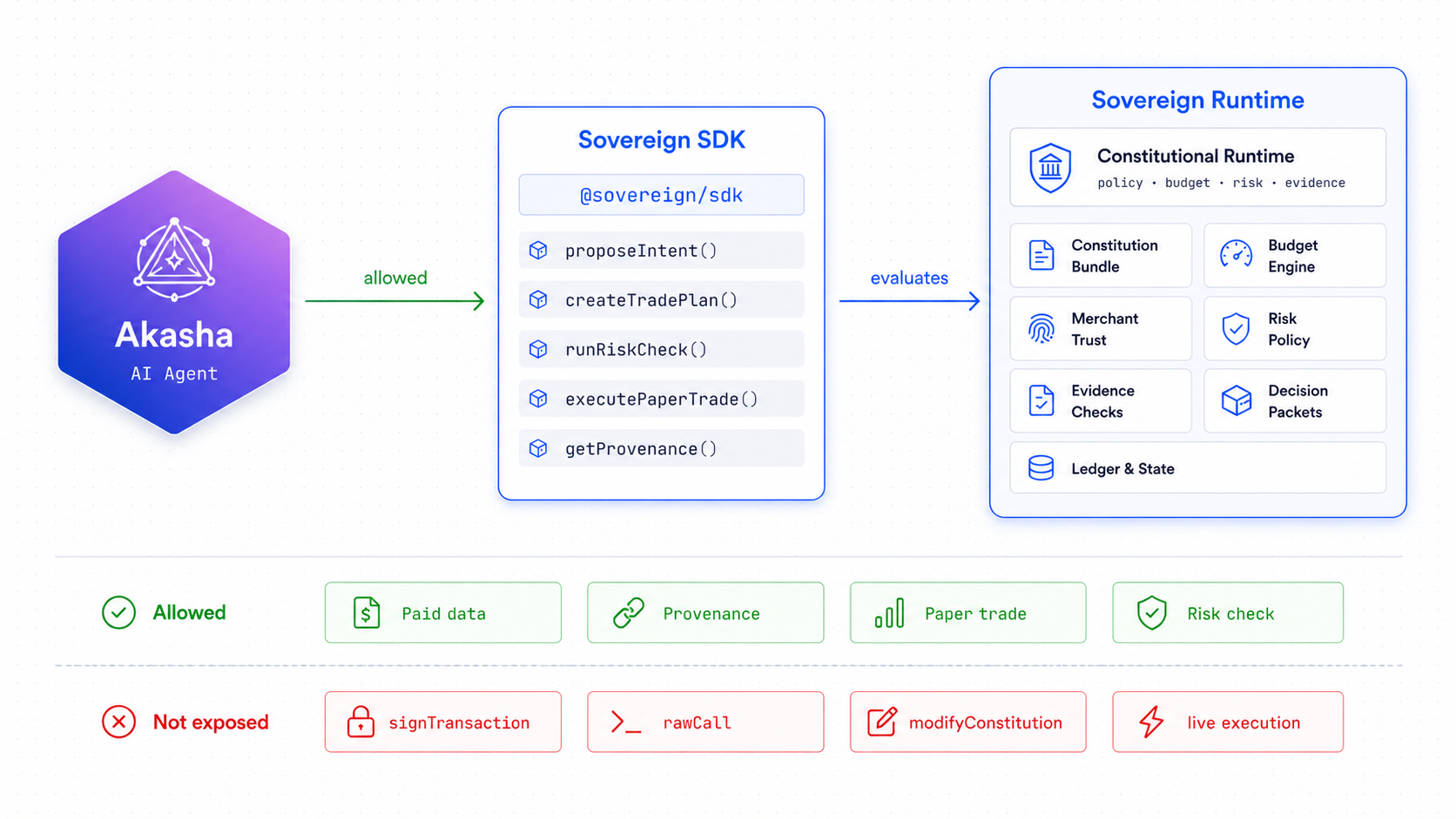
Integration model
Akasha interacts with Sovereign exclusively through the public SDK. There is no internal shortcut, privileged API, or elevated permission level. She is treated as any other SDK client: she submits intents, receives decisions, and queries records.
@sovereign/sdk. No internal bindings.
No privileged routes. Same interface any developer uses.
What Akasha can do
- Submit paid data requests to the procurement wallet
- Look up provenance for data artifacts she purchased
- Create trade plans from paid data artifacts
- Request risk checks on trade plans
- Request paper execution of risk-approved plans
- Query accounting export for her settled actions
What Akasha cannot do
- Sign transactions — no signing surface in the SDK
- Execute live trades — denied by default, requires escalation
- Withdraw or deposit from wallets
- Adjust leverage or position limits
- Modify wallet policy or constitutions
- Approve or register new merchants
- Adjust budget limits
- Access another agent's records
Akasha's flow
Why this matters
Akasha is an autonomous agent with real research, execution, and memory capabilities. The Sovereign integration shows that these capabilities can be bounded economically without removing the agent's ability to act.
She can conduct machine commerce, build trade plans from paid intelligence, and execute in paper mode — all with full auditability, provenance, and budget control. The live trading block demonstrates that even a capable autonomous agent cannot override the constitutional controls.
SDK usage example
import { SovereignClient } from "@sovereign/sdk";

// Akasha initializes the same SDK any developer uses
const sovereign = new SovereignClient({
  baseUrl: process.env.SOVEREIGN_API_URL,
  agentId: "akasha_agent"
});

// Request market data through the procurement wallet
const result = await sovereign.proposeIntent({
  walletId: "wallet_procurement_demo",
  agentId: "akasha_agent",
  kind: "mcp.paid_data_request",
  merchantId: "merchant_akasha_market_data",
  routeId: "route_eth_snapshot_v1",
  taskId: "eth_market_cycle_001",
  idempotencyKey: crypto.randomUUID()
});

// On approval, use the artifact for trade planning
if (result.status === "approved") {
  const plan = await sovereign.createTradePlan({
    artifactId: result.artifactId,
    symbol: "ETH/USD",
    direction: "long",
    size: "0.1",
    rationale: "cycle bottom from ETH market data"
  });

  const risk = await sovereign.runRiskCheck(plan.planId);

  if (risk.passed) {
    const order = await sovereign.executePaperTrade({
      planId: plan.planId,
      riskCheckId: risk.checkId,
      walletId: "wallet_trading_demo"
    });
  }
}