Base agents
Agents submit EconomicIntent through Sovereign instead of receiving unchecked wallet authority.
Sovereign Wallet OS is a Base-first framework that lets autonomous agents request x402 payments and other economic actions through policy-bound wallets instead of receiving raw wallet authority.
Built for Base agents, USDC service payments, merchant trust, data provenance, auditability, and governed trading workflows.
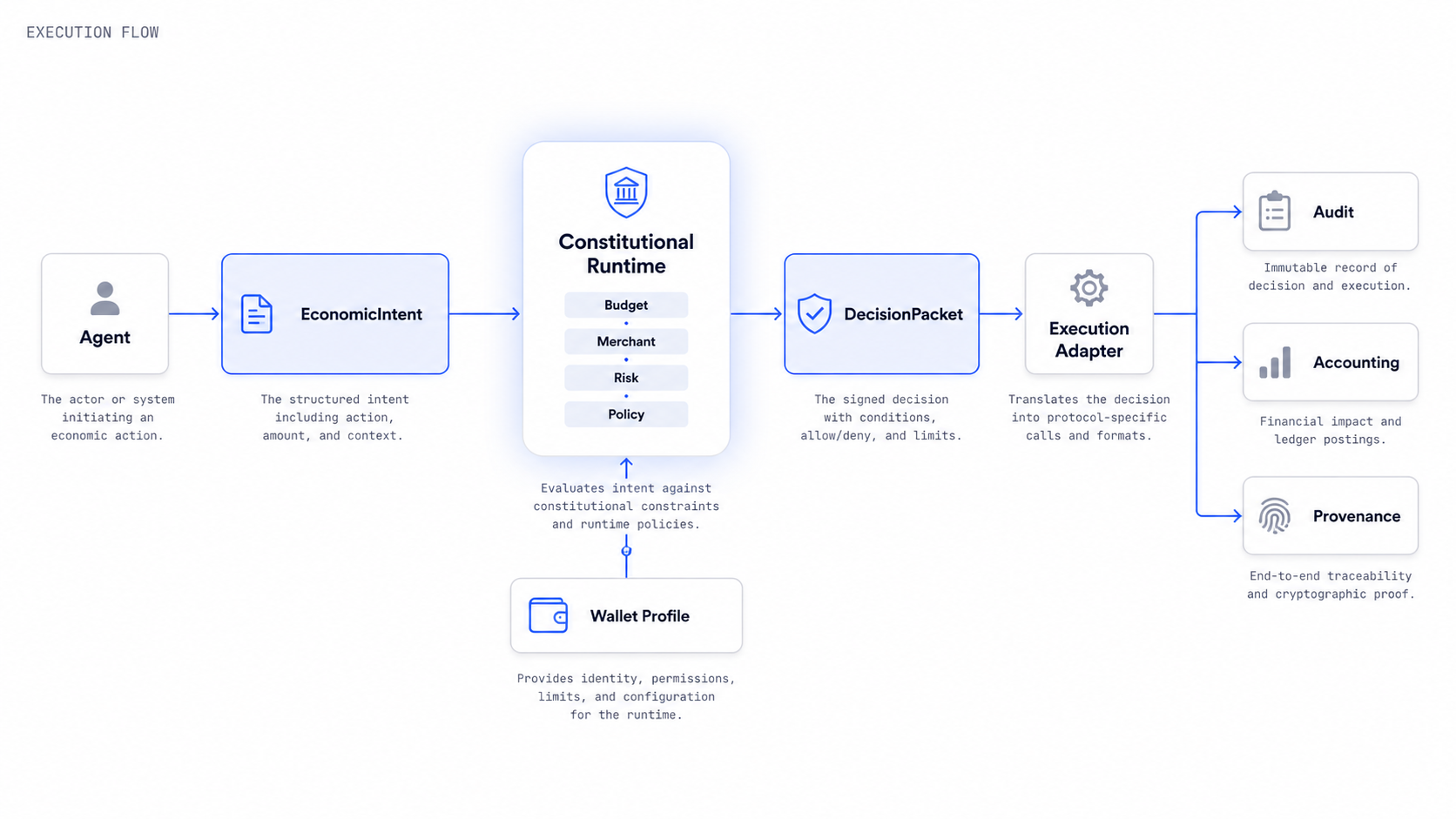
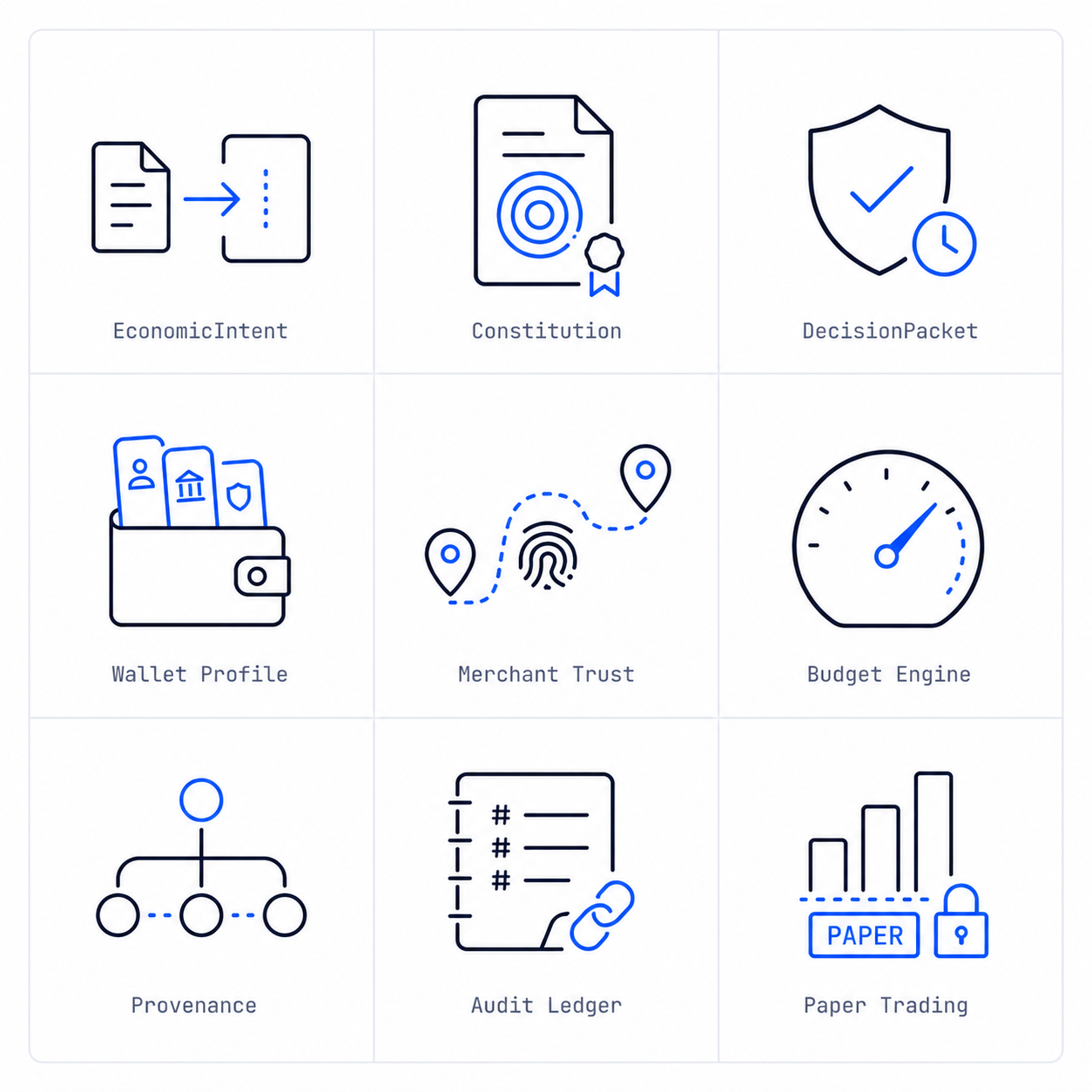
Base gives agents wallets, x402 payments, stablecoin settlement, and onchain execution. Sovereign adds the missing governance layer: constitutions, budget controls, merchant trust, decision packets, provenance, and audit trails.
x402 lets an agent pay an API.
Sovereign decides whether the agent may pay.
Agents submit EconomicIntent through Sovereign instead of receiving unchecked wallet authority.
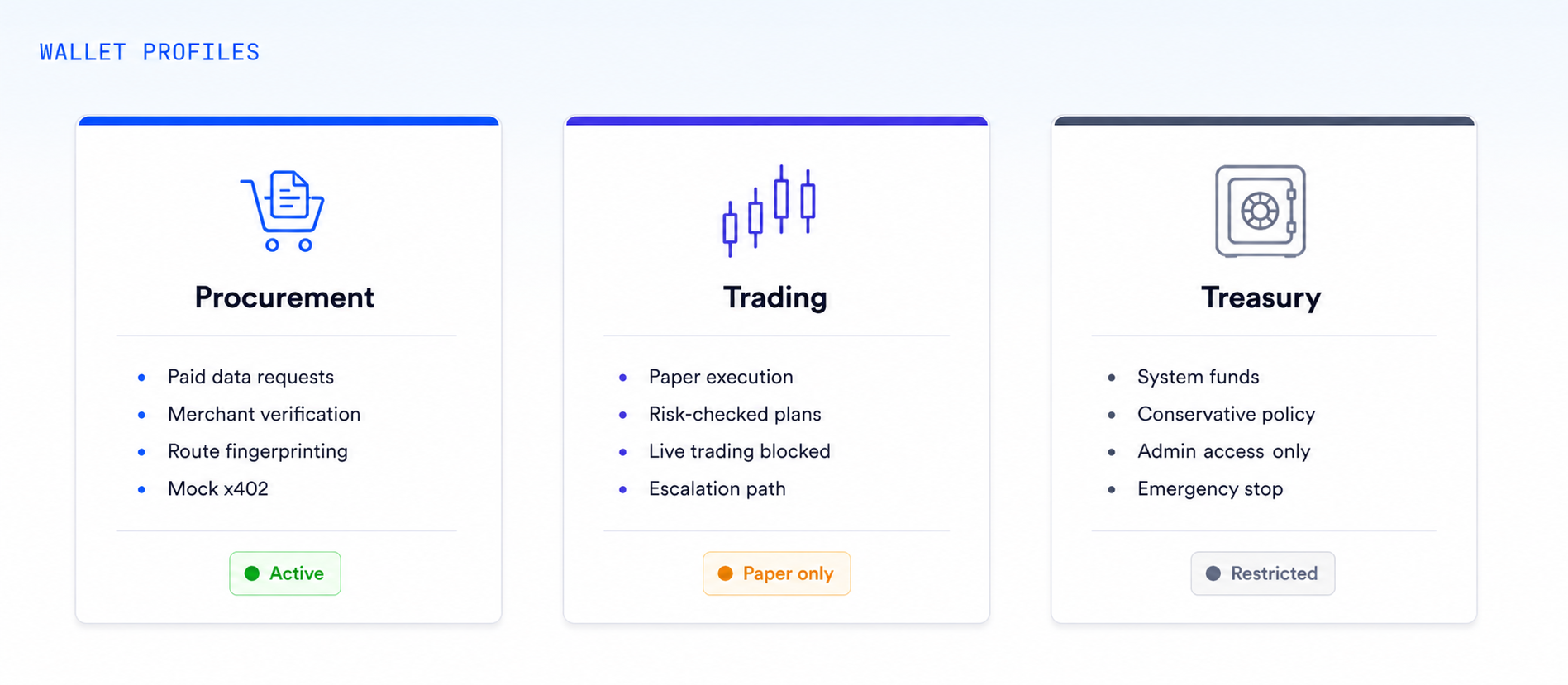
Procurement wallets govern paid API and data access through x402-style payment flows.
Agent spend is modeled around USDC-denominated service payments on Base.
Future Base transactions can carry Builder Codes for app, wallet, and agent attribution.
Most agent systems focus on what an agent can do. Sovereign focuses on what an agent is allowed to do economically.
A model-selected tool call should never become unchecked spending power.
Economic actions should be evaluated against wallet-specific constitutions, budgets, counterparties, and risk constraints.
Every purchase, artifact, and downstream decision should be traceable, auditable, and accounting-ready.
Each wallet profile carries its own authority surface, budget limits, permitted merchants, and risk tolerances.
Every economic action flows through a typed intent, a wallet constitution, and a scoped decision packet before execution touches anything real.
Procurement, Trading, and Treasury wallets each carry their own authority surface and compiled constitution.
Agents submit typed requests instead of receiving direct signing access. No raw call surface.
Active wallet policy evaluates budgets, merchants, risk, and execution context before any action.
Approved actions receive scoped, expiring, replay-protected authorization. Nothing executes without one.
Routes are fingerprinted. Payee drift can deny or quarantine a merchant before any payment lands.
Paid data artifacts are linked to the wallet, merchant, decision, and every downstream trade plan.
Settled actions generate double-entry journal entries and exportable CSV records automatically.
Paper execution is risk-checked and bounded. Live trading is denied or escalated by default.
Reservations, commits, releases, and reversals keep spending bounded per wallet at runtime.
The runtime evaluates typed intent before any economic action executes. No raw wallet access. No unchecked spending.
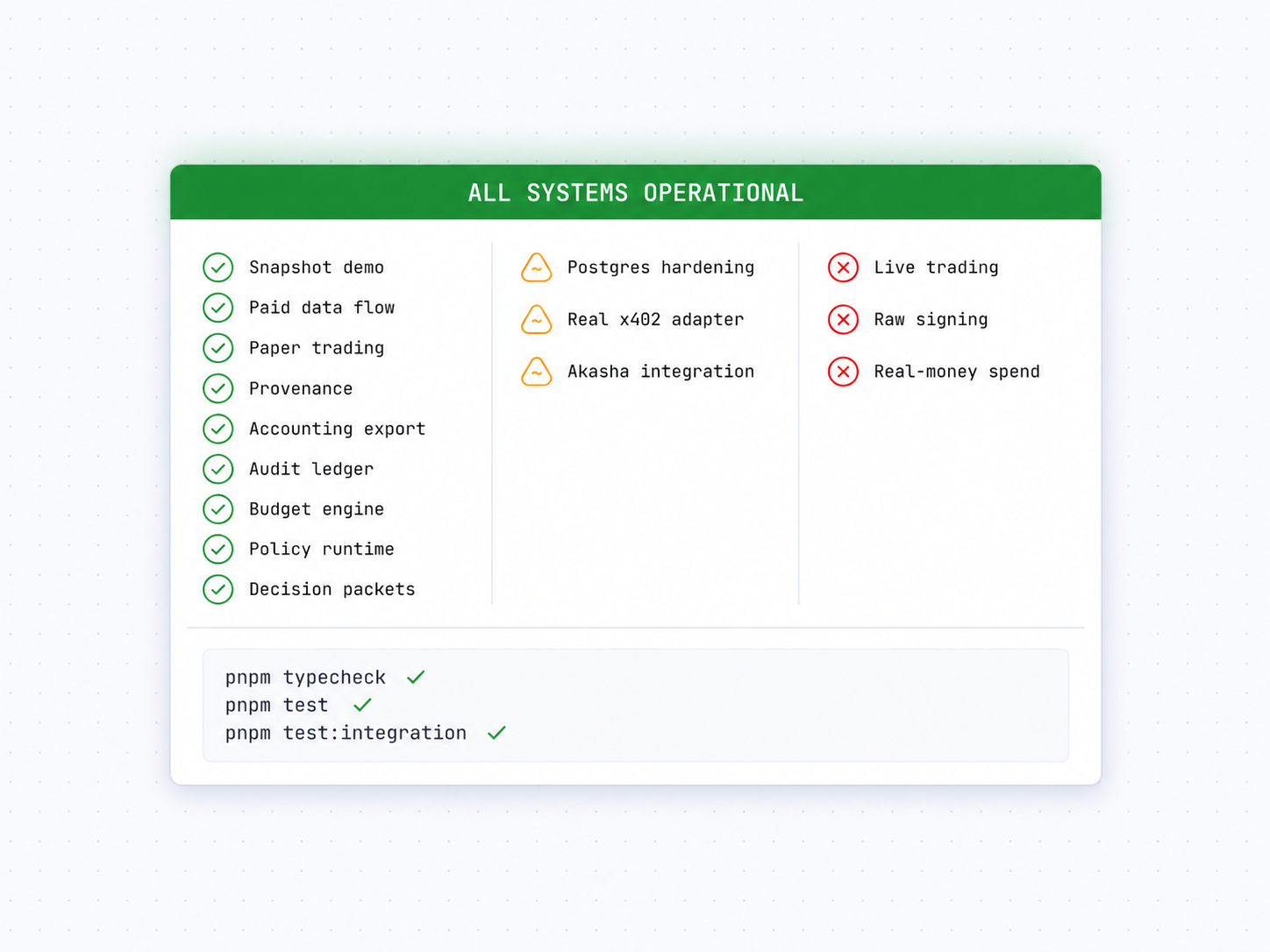
These flows are built, tested, and runnable in the developer demo today.
Agents buy approved data through a procurement wallet instead of making direct purchases.
If a merchant route changes unexpectedly, the runtime blocks or quarantines it before any payment.
Each paid artifact is linked to the merchant, route, wallet, decision, and downstream usage.
Trading wallets approve bounded paper execution from risk-checked trade plans only.
Live trading remains denied by default. Selecting a tool never automatically executes it.
All core flows are implemented, tested, and runnable. The demo proves the framework rather than just describing it.
pnpm typecheck
pnpm test
pnpm test:integration
pnpm test:postgres
Snapshot mode for local demos · Postgres for durable validation
Akasha is being integrated as the first agent client through the SDK-only path. She can request paid data, inspect provenance, create trade plans, run risk checks, and request paper execution.
She cannot directly sign transactions, trade live, alter wallet policy, or bypass constitutional controls.
Akasha is the first live agent client. Watch her submit economic intent, receive a decision packet, execute a paper trade, and get blocked from live trading — all in real time.
Open Akasha Control Room →Seed the demo, request paid data, create a paper trade, inspect provenance, export accounting records, and verify blocked live execution.
pnpm install
pnpm dev:api
pnpm demo:paid-data
pnpm demo:paper-trade
pnpm demo:provenanceAgents should have constitutions,
not raw wallets.
— SOVEREIGN WALLET OS CORE PRINCIPLE